
Wounded to wonder

Text of the opening speech by drs. Jan van Veldhoven, Dutch language and literature specialist.
WOUNDED TO WONDER
This exhibition by Hans Vandenberg is a retrospective. Not in the sense that his complete work can be seen here. But in the sense that you will get a good representative impression of the various types of paintings he makes. Diverse in genre, diverse also in intention. He himself speaks of impressionism and realism. On a previous occasion, for what it is worth, I added the terms pseudo-realism and hyperexpressionism. Diverse in approach, detailing, color palette and type of paint. All this diversity in our multi-pictorial society ultimately does not detract from the coherence in his work. Looking at the exhibition as a whole, there is unity in diversity. Development on various lines, that come together, diverge and come together again. A painter's hand that remains recognizable. A painter's eye that sees and revises. A painter's heart that searches, that finds, that loses and rediscovers. And this last point, that is of course the most intriguing at this special moment. We know that Hans is a master of his craft. And that this teacher can explain the craft excellently if we want to know more about it, no problem. But an exhibition like this is not primarily an act of competence. It is a personal, artistic testimony. And then comes that one question. Not the question of how he did it. Not the question: What was the painter's intention? No, then comes the question: What inspired Hans Vandenberg when he made all those paintings? What made hand, head and heart come together? Wonder, he says himself. 'Wonder is my source of inspiration. I am constantly looking for the essence of things that move me, that fascinate me. I dip my paintbrushes in oil or acrylic paint to give shape to my own visual language, my own experience of a scene, or of the character of a person or an animal.' Wonder, then. So? You should never take a painter at his word. Painters speak with paintings. So, on to the paintings. So I wandered around in his studio, on his website, at this exhibition. And I saw that it is true, that uniqueness born from apparent wonder. 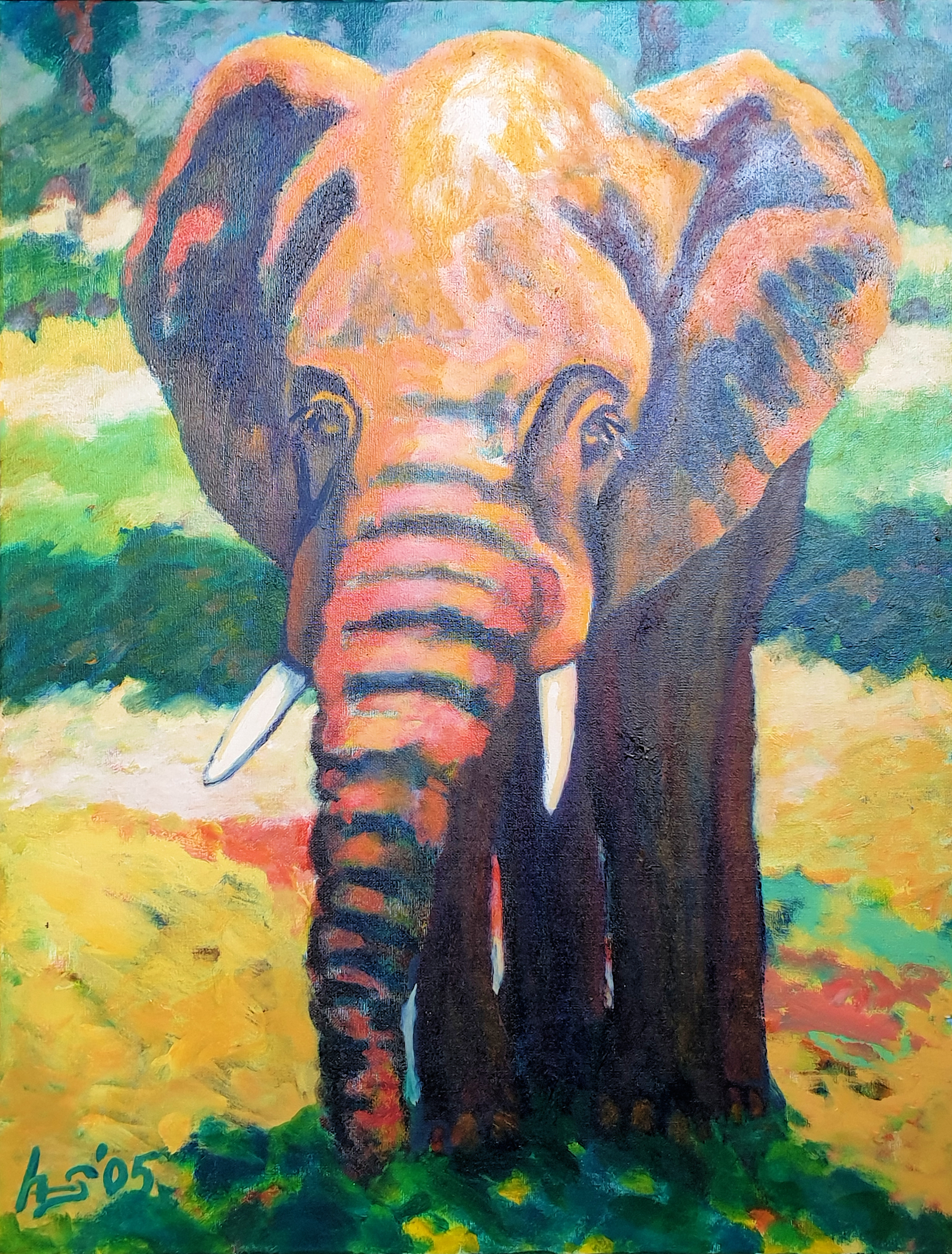 I see an elephant, which is head and colour and is unwavering. While I know those colossuses as grey and trunk and tree trunks of legs and improbably careful. I see Pegasus, the winged mythological horse of poets. However (following the Venus de Milo I would almost say) the wings are missing. 'They are not necessary', the painter seems to say, 'you can see that he is landing, those wings would only disrupt the image'. 'And look at that halo, the sparks are flying'. I see in the halo a truly dazzling variation on Armando's famous wheels, and I am won over. Further on hang paintings about love and passion.
 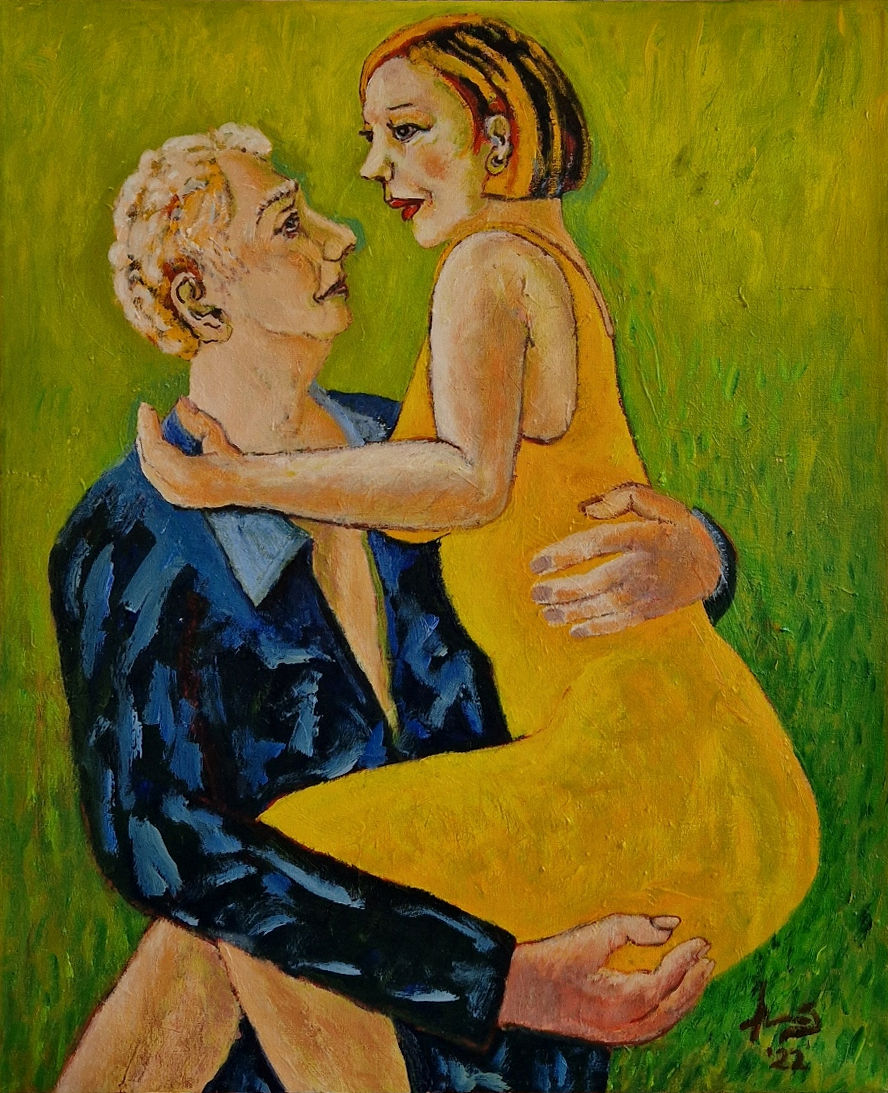 'Lovers'. Look, he is carrying her. But does she want to? Yes, look at the way she holds his head. But those eyes... She does have that head, but perhaps she has lost her heart, really lost I mean. And on the other hand. 'Balancing'. A young man (incidentally an idealized self-portrait of the painter), pours water from one jug into the other to restore the balance. In this restoration, a lot of liquid is lost, but both the young man and the liquid seem to have long since passed the limit of any limitation. 'Vote ANC'. On the one hand, this painting is much more of a statement than the lyrical question marks that just passed by. But nevertheless, above all an image. A colorful image. An image of a colorful hopelessness. And I could go on like this for a while, when it comes to paintings with an intrigue. I won't, go and see for yourself. On the other hand, there are also a number of paintings in this exhibition that, if I may say so, are enough on their own. A feast of image and color. Pure lyricism. Poppies that have completely lost their vulnerability, so that they robustly dominate the image as mere areas of colour.
 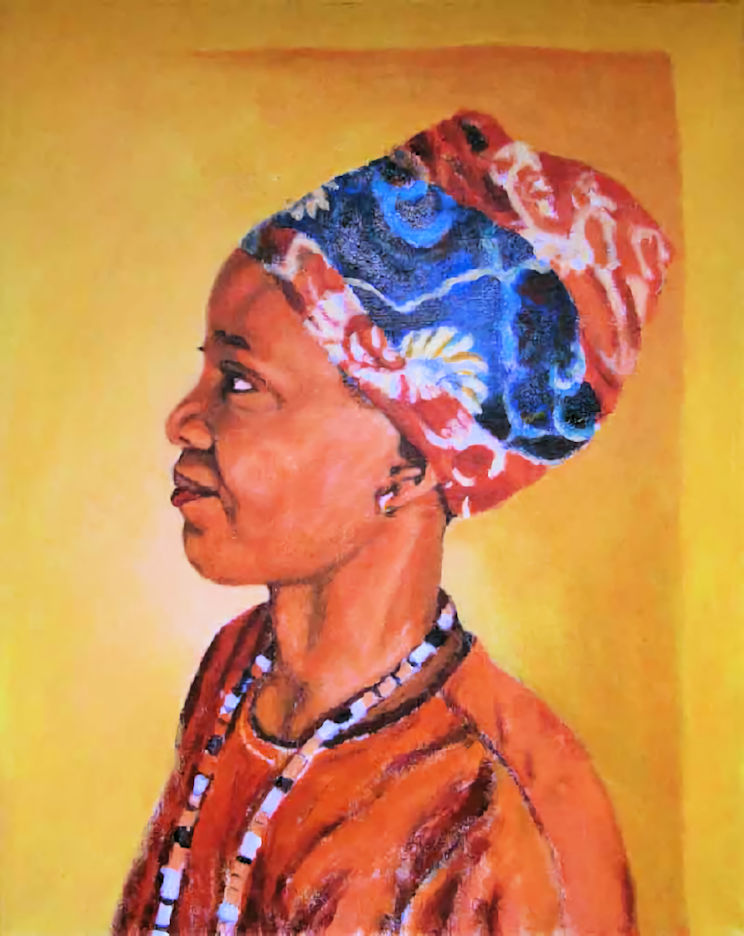 Or the portrait of the African with a headscarf, of which the headscarf in particular becomes the painting. And there are more, of those unambiguously lyrical paintings, but that is a search. After all, Hans Vandenberg's paintings have something ambiguous. They are either staged to depict an idea such as the fight for love, or the mythical depiction of inner struggle, or a social problem. Or in the purely lyrical depiction that they may have originally pursued, they have strayed from the unambiguous path somewhere along the way. They may have ended up somewhere else, perhaps not entirely intentionally but still inevitably. There is always something gnawing at the beauty, the idea, the love as Hans Vandenberg depicts it. His wonder arises from a wound. Not a wound that will kill you. No, more a wound like a tree nurseryman makes on a trunk or a branch. A wound from which a new shoot can sprout, or on which a new plant can be grafted. A productive wound. A wound that becomes a wonder. A fascination. That gives wonderful work. And an admirable exhibition. It is a great privilege for me to be able to declare it open here.
Drs. Jan van Velthoven, 's-Hertogenbosch, De Muzerije, 11 March 2006
Exhibition 'Moments of wonder' by Hans Vandenberg